


The usual signs of a failing engine are easy to list: a rough idle, stalling, a temperature spike, a knock, a puff of smoke, or a glowing warning light. None of them proves the engine is dead. They prove something is wrong, and the gap between those two statements is where people lose thousands of dollars. Five checks, done in order, close that gap before anyone approves a replacement.
1. Read the codes, but do not stop there
Gasoline cars sold in the US from the 1996 model year on carry an OBD-II port, according to the EPA’s rollout of the rule, and a basic scan tool is cheap. A steady check engine light with a code like P0300 indicates a random misfire. Kelley Blue Book’s code library notes that a flashing light signals a severe misfire that can damage the catalytic converter, so a flashing light means you should park the car. Most misfire codes trace back to worn spark plugs, coils, or fuel injectors, which cost far less than an engine. Codes narrow the search. They never settle it.
2. Match the smoke to the problem
The Iowa Department of Natural Resources publishes a tailpipe smoke chart that is a good first reference for gasoline engines.
- Blue smoke: engine oil is burning, which can mean worn piston rings, valve seals, or cylinders.
- White smoke that lingers: coolant may be entering the combustion chamber through a bad head gasket or a cracked head. Thin white vapor on a cold start is normal and needs no fix, the same chart says.
- Black or gray smoke: the mixture is too rich, often from a clogged intake filter or a fueling fault, though low compression can contribute.
The state chart itself says it is a guide and not a substitute for a technician. Smoke tells you which test to run next.
3. Run a compression test
This is the step most guides get right and most owners skip. With the engine warm and the plugs out, crank each cylinder five to ten times and record the highest reading. AMSOIL’s technical blog offers two working rules of thumb: roughly 130 psi or more per cylinder on a sound engine, and no more than about 10% variation between cylinders. Your manufacturer’s specification beats any rule of thumb, so look it up first.
The pattern matters more than a single number. One low cylinder usually points to a problem with that cylinder’s valve or rings. Two low neighbors suggest a head gasket between them. If every cylinder reads low by a similar amount, suspect general wear or a timing belt that has jumped a tooth, since a burned valve usually affects a single cylinder.
If the numbers say the engine is finished, a replacement becomes the practical question. Specialists such as jdmenginedirect.com organize imported Japanese-market engines by make and model, which helps when a compression test has just confirmed the old one has failed. Compare options and warranty terms before you commit.
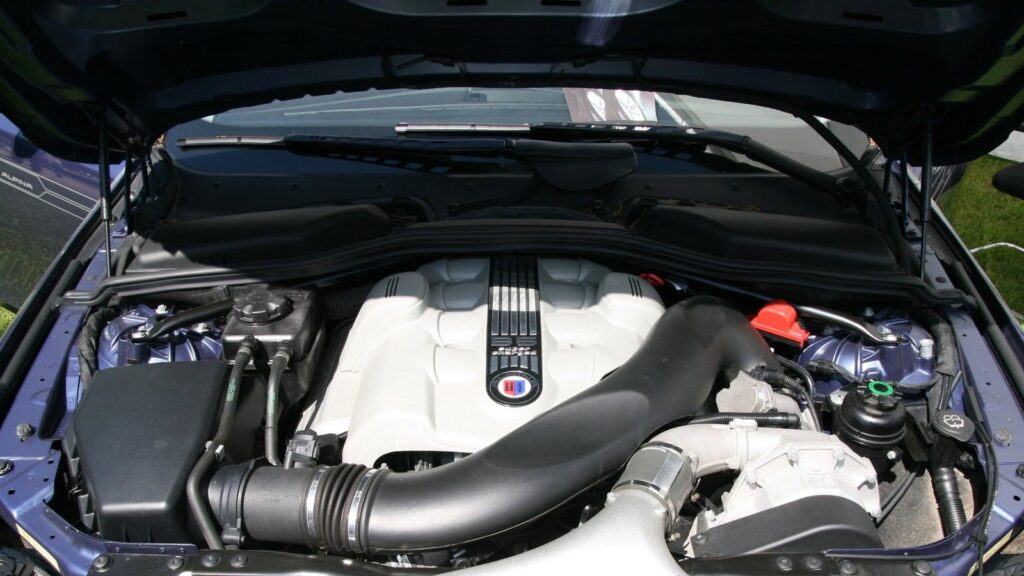
An engine bay with the hood up, ready for inspection. Photo: Wikimedia Commons contributor, public domain
4. Follow with a leak-down test
A compression test says a cylinder is weak. A leak-down test says why. The tester feeds regulated pressure into a cylinder at top dead center and shows what percentage escapes. AutoZone’s guide gives common readings: under 10% is good, over 20% suggests worn rings, damaged valves, or seats, and over 30% means serious trouble. Then you listen, as Mobil’s leak-down guide explains. A hiss from the oil filler points to the rings, a hiss from the intake points to an intake valve, and a hiss from the exhaust implicates an exhaust valve. Bubbles in the radiator suggest a head gasket or a crack.
5. Send the oil to a lab
Oil analysis costs little next to an engine, and it reveals what a gauge cannot. Blackstone Laboratories explains that its reports show wear metals such as iron from cylinders and aluminum from pistons, plus contaminants like fuel, antifreeze, and moisture. One reading is a snapshot. A second sample a few thousand miles later shows whether the trend is stable or climbing. Antifreeze in the oil is the red flag, because Blackstone notes that a serious leak can destroy an engine.
What the results mean for your wallet
Three outcomes cover most cases.
Healthy numbers, bad symptoms. The engine is fine and something around it is not. Fix the ignition, fuel, or sensor problem and avoid the cost of an engine replacement. A rough idle alone is a symptom, not a verdict, and most hot-running complaints turn out to be cooling-system problems.
One cylinder or the head gasket. A repair can make sense if the block and bottom end are good. Hagerty’s long-running mechanic columnist recommends ruling out other causes of overheating and confirming the diagnosis with compression, leak-down, and exhaust-in-coolant checks before pulling a head.
Widespread wear, knock, or metal in the oil. The picture here is bleak. One independent garage’s published guide suggests budgeting $3,500 to $6,000 or more to fix rod knock properly, and it cites a common rule of thumb: compare the cost of the fix with replacing the engine or selling the car once the bill nears 50% to 60% of the car’s value. Treat that as one garage’s estimate, but the rule is a useful sanity check. When several tests agree that the bottom end is gone, swapping in a used engine often beats a rebuild on both cost and downtime.
Whatever the verdict, ask the shop to put the test results in writing. A diagnosis that comes with a compression chart, a leak-down sheet or an oil report is one you can take to another garage for a second opinion. And if a mechanic recommends a replacement without a single measurement, that is the moment to ask for one.